It's been a long time since the last update, but I just haven't been able to catch up with a computer until today here in Forbes.
My last day in Hopetoun was another windy one, so I spent much of the day riding around town seeking shelter. At least I wasn’t riding into it. I did connect with Bonnie via FaceTime, as she was just finishing her ski trip in Utah, with five guys from the ski club.
In Hopetoun I learned about the pipeline system they’ve built in Victoria to distribute water. It replaced a system of open canals, from which some 90 percent of the water was lost. That’s one reason the area seems to have so much more water now.
I’m also seeing drinking water taps in parks. Since the bore water in this area is usually unpalatable, they must be treating surface water. It doesn’t always taste great, though.
The “Bush Retreat” in Hopetoun allows free camping along most of the lake shore. The sites are just the usual patches of dirt. A short section of lakeshore adjacent to the Retreat, however, is a park with grass, tables, and a shelter. In other words, a perfect campsite. There were no signs, but it was clearly not a camping area. My first night there, after checking the locations of the sprinklers, I waited until dark to put my tent up, and took it down early in the morning.
That afternoon, I was hanging out in the shelter, all my gear loaded on the bike, when a friendly guy I took to be the caretaker came by. He asked me where I was going to camp, and I told him somewhere in the Retreat. He then suggested I just put my tent up on the grass there! Naturally, I agreed.
The following morning, just as I was starting to take down my tent, the Grouch arrived. The first clue was the nasty look from his little dog.
“Absolutely no camping on the grass,” barked the Grouch.
“The caretaker said it was OK.“
“We don’t have a caretaker.“
“The guy who cuts the grass.”
“Well, I’ll find out who he is!”
No matter, I was leaving anyway. I suppose every town has one of these.
 |
| Mallee Tree Windbreak |
The next day to Sea Lake was a long one, right into a vicious northeast wind. Just before the village of Lascelles, one of my shifter cables broke. I limped into Lascelles, where I at least had a nice shelter for the repair. I had a terrible time getting the old cable out, so I lost an hour. (Why didn’t I replace that cable BEFORE the trip?)
Sea Lake has a pretty dismal caravan park, but I knew that. The next day I actually had a tailwind part way to Swan Hill. Then the first rain of the trip arrived. Not much, but just enough to make me stop several times to don rain gear. There was heavy rain to the south, but I just caught the edge of it. There was more rain overnight, but it cleared the next afternoon. That was a rest day in Swan Hill, as I waited for the bike shop to open on Monday. I replaced the other shifter cable (before it broke!), and did some other chores. I once again have a kilogram of milk powder for breakfasts.
 |
| Murray River Bridge |
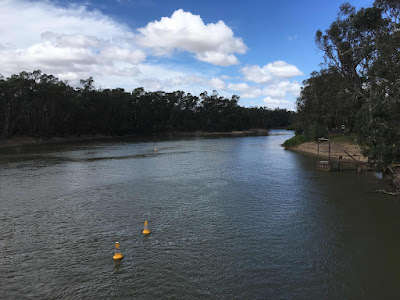 |
| Murray River at Swan Hill |
Monday morning, the bike shop did open, so I was able to buy another pair of bike shorts and more shifter cables. Then it was a very easy ride to Moulamein on a great tailwind. Along the way, a guy with an empty trailer offered me a ride. Where are these guys when I’m slogging into the wind in the rain?
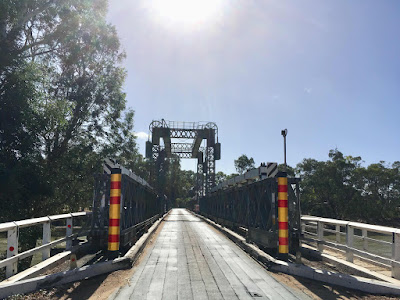 |
| Crossing the Murray |
 |
| On the Road to Moulamein |
Moulamein in the first stop in New South Wales. It’s a nice little town, with all the essentials. The caravan park is still run by Sandy and Joe, two friendly artists I met in 2015. Sandy does ceramics, while Joe does mostly wood and metal. Campsites are cheap, and even have grass and tables, so I took another day off. They asked me to pay an extra $5 for a powered site to charge my phone, which is extremely expensive electricity, but I'm helping support artists.
 |
| Moulamein Campsite |
 |
| Sandy's Artwork |
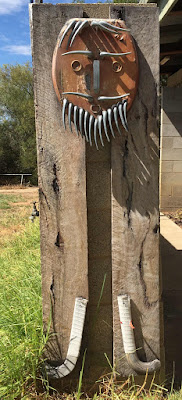 |
| Some of Joe's Work |
 |
| Sandy and Joe |
Shortly after arriving in Moulamein, I learned of the “Confest” nearby the next weekend.
Several thousand people are expected. What the web site doesn’t mention, but several locals did is that clothing is optional. I was to be far away.
After that bit of rain to Swan Hill, and aside from a very brief shower one morning, it’s been sunny and warm. Some days have been up to 35 C, and the nights cool, but warmer than earlier. Winds have been variable, but generally north, where that warmth comes from. One of these days, a “change” is bound to arrive.
The ride from Moulamein to Maude was a long one, with no help from the wind. Maude consists of a tiny store and a pub, which also has a caravan park. The price of camping had tripled since 2015, but at least they're still in business.
 |
| Barren Country to Maude |
 |
| The Maude Pub |
It was an easy ride with a tailwind to Hay, where I needed to arrive before the post office closed to pick up the new bike shorts Bonnie sent me. The next day was Good Friday, when absolutely everything in Australia is closed.
Hay had nice campsites at the showgrounds, where I camped two nights. I had a pretty nice tent site, with no extra charge for the horse manure. There was a nice shelter by the grandstands, well protected from the wind, where I spent much of the next day. There wasn't a laundry, but the caretaker loaned me a bucket. It was a very quiet Good Friday.
I suppose age does have some advantages: I can no longer smell the roadkill, nor the horse manure around the tent.
 |
| More Barren Country to Hay |
 |
| Hay Campsite |
 |
| Nearly Full Moon in Hay |
 |
| Hay Showgrounds on Good Friday |
The next stop was Booligal, which consists of a pub and a nice campsite by the sports grounds. A friendly caretaker, and no grouch.
 |
| Still No Tree |
 |
| On the Road to Booligal |
 |
| The Booligal Pub |
 |
| Another View of the Booligal Pub |
 |
| Booligal Campsite |
The ride to Hillston the next day was tough, as I knew it would be. Most of the 78 km route is gravel, and half of that very bad. I had plenty of water this time, though.
 |
| The Road to Hillston |
 |
| Dry Weather Road |
 |
| Earth Return Power Line |
 |
| Flat, Flat, Flat |
 |
| Getting Closer to Hillston |
After that, I took a day off in Hillston, a nice town. Except for the thorns. The first morning, both tires were flat, and again the next. I finally figured out that it was the footpath I was using to ride into town. Now I check for thorns every morning.
 |
| Hillston Birds |
After patching the tires again, I got a late start to Lake Cargelligo, the longest ride so far. A bit of a tailwind helped. Just short f the town, these strange bumps appeared on the horizon. I even had to ride over some of them. It’s been a while.
 |
| Hills Approach Lake Cargelligo |
Lake Cargelligo is another very small town, and I was almost out of tire patches. There was a little sports shop, run by an extremely elderly gentleman. He said he was “a little deaf”. It took a while to get the message across, but he actually had some!
.
 |
| Lake Cargelligo Shop |
Lake Cargelligo is a nice town, but I was on a schedule to meet some friends in a few days. The next stop was supposed to be Condobolin, a ride of over 100 km, much of it gravel. I got a late start, and there was a bad headwind, so after 29 km to Euabalong, I quit for the day. There’s nothing there but a campground and a pub. There was plenty of rainwater in the tank. Also, I learned at 3 AM, lots of roosters.
Oh well, I had planned to get up at 5, anyway. The gravel to Condobolin can be avoided, but it’s longer, and headwinds were forecasted. (Sunrise was about 6:15.). That helped, and I covered the 93 km by 1:30.
Condobolin is a larger town, but plagued by rampant vandalism. In spite of massive fortifications, all the public facilities are trashed. There’s a nice caravan park, though, and they even let me put my tent in a nice, but nonstandard, place.
One thing I’ve noticed is the improvement in tap water in towns since my earlier trips. In this area, though it was usually safe, it tasted terrible, so everyone drank rain water. They seem to have mostly fixed that now.
The ride to Forbes was again the longest so far, 105 km, but all sealed and light winds. I was on the road at 7 AM, in town by 2. As the sun set about 6, and there are chores to do, the rest of the afternoon quickly disappears.
Proceeding east up the Lachlan River valley towards the mountains, things start looking greener and there are more signs if habitation. There are also a lot more trees.
 |
| More Trees Approaching Forbes |
Forbes is the biggest town I’ve been in since Swan Hill. It’s a bit sprawly, the caravan park about 2 km from the center. Like Condobolin, it also shows signs of vandalism, but it has all the usual businesses. I’ve learned it has endured many floods from the Lachlan.
Because of the variability of winds, it’s hard to tell if I’m really getting faster, but I feel better for longer at a stretch on the bike. It’s definitely taking longer to get in shape, but I’m thankful to still be pedaling!
From here, I have several shorter days to meet my friends in Yeoval on Monday. I’ll still have plenty of time to catch that bus to Brisbane, but there are two 122 km days in there, and I want some margin for bad weather or headwinds.